

These printable speech therapy worksheets give parents, teachers, and homeschoolers ready-to-use activities that build vocabulary, comprehension, and conversation skills through classroom and home practice. This article covers general language and communication development rather than clinical speech-language pathology exercises. Common types include vocabulary boosters, comprehension prompts, and conversation starters, and packs like those from Theedhed pair these formats with age-appropriate, instant-download design.
TL;DR:
- Worksheets should incorporate generative tasks that require children to produce or explain language rather than recognize answers to ensure meaningful learning.
- Design worksheets with clear, specific goals and create multiple difficulty tiers to adapt to each child’s skill level and prevent disengagement.
- Use worksheets as part of a broader interaction sequence involving modeling, guided practice, and extension conversations to maximize language development.
- Incorporate visual supports and sentence frames, especially for young children and English learners, to make tasks achievable and reduce reliance on text-only instructions.
- Pair printable or digital worksheets with daily routines and content areas, embedding language practice into existing activities for more effective and natural learning.
Table of Contents
- What Types of Speech Therapy Worksheets Work Best?
- How Do You Design a Worksheet That Actually Builds Language?
- How Should Adults Use Worksheets Alongside Real Interaction?
- Five Ready-to-Use Worksheet Templates You Can Build Today
- How Do These Worksheets Fit Into Everyday Routines?
- What Makes a Worksheet Actually High Quality?
- How Do You Customize Worksheets for Different Learners?
- Should You Use Digital or Printable Worksheets?
- What Goes Wrong With Worksheets, and How Do You Fix It?
- Shaun’s Take on What Makes a Printable Worksheet Actually Work
- Ready-to-Download Worksheet Packs From Theedhed
- Sources
- FAQ
What Types of Speech Therapy Worksheets Work Best?
The right worksheet depends entirely on what skill you’re targeting. A vocabulary goal needs a different tool than a listening goal, and matching the format to the goal is what separates a worksheet that teaches from one that just fills time.
Here’s how the main categories map to common goals:
- Vocabulary building: word banks, categorization sorts, and “odd one out” tasks that force a child to explain a choice rather than just circle an answer.
- Receptive comprehension: wh- question sets (“who, what, where, when, why”) and sequencing tasks that check whether a child actually understood a passage or picture story.
- Expressive language: story retell prompts and sentence-building frames that require the child to produce language, not just recognize it.
- Conversation skills: role-play scripts and choice-making prompts that mimic real back-and-forth exchange.
- Listening and following directions: multi-step task cards that test whether a child can hold two or three instructions in mind at once.
Age matters as much as category. A kindergartner does well with a two-step direction card and a picture-based vocabulary sort. A fourth grader can handle a three-step direction card and a categorization task that includes abstract words like “loyal” or “curious.” For grade-specific grammar and vocabulary structure, a phonics, spelling, or comprehension worksheet guide can help you match format to skill level.
In a classroom, these worksheets often run as a rotation station while the teacher works with a small group. At home, the same worksheet becomes a fifteen-minute after-dinner activity, ideally with a parent narrating alongside the child instead of just handing over the page.
How Do You Design a Worksheet That Actually Builds Language?
A worksheet only works if it makes a child produce or process language, not just guess the right shape on a page. That distinction drives every design decision below.
Start with a specific, measurable goal rather than a vague one. “Improve comprehension” tells you nothing about success. “Identify three main ideas from a short paragraph” or “use past tense correctly in a four-sentence retell” gives you something you can actually check off.
- Write the goal first, then build the task. A goal like “restate the main idea in two sentences” prevents the worksheet from becoming a matching exercise with no real thinking required.
- Favor generative tasks over recognition tasks. Rephrasing, sequencing, and explaining require the brain to construct language. Multiple-choice and matching let a child succeed through pattern recognition alone.
- Build in three difficulty tiers. An entry-level version uses picture supports and shorter sentence frames. An on-track version drops some scaffolding. A stretch version asks for a fuller, unsupported response.
- Add visual anchors and sentence starters for English learners. A sentence frame like “First, the character felt ___ because ___” turns a blank page into an achievable task.
- Run a two-minute vetting check before using any worksheet. Ask: Does it have one clear goal? Does it require producing language, not just selecting it? Can I tell if the child improved by looking at the finished page?
Design guidance from practitioner research on worksheet construction backs this generative-over-recognition approach directly, and it lines up with a broader pattern in the language development research: a 2025 meta-analysis of 71 studies found a moderate but consistent link between caregiver speech input and child language outcomes. Worksheets alone don’t create that input. The adult sitting next to the child does.
Pro Tip: If a child finishes a worksheet in under two minutes without any wrong answers, the task was too easy to teach anything. Bump them to the stretch tier next time.
How Should Adults Use Worksheets Alongside Real Interaction?
Worksheets work best as a supplement to conversation, not a replacement for it. Handing a child a comprehension sheet and walking away skips the step that actually builds skill.
The most reliable sequence looks like this: model the skill first, guide the child through one example together, then let them finish the rest independently, and close with a few minutes of extension talk about what they wrote. That last step matters more than most people assume, since it’s where a child gets to use the new vocabulary or sentence structure out loud.
The PC-TALK framework from the Juniper Gardens Children’s Project outlines five strategies that pair naturally with worksheet practice:
- Narrate what’s happening: describe the task out loud as the child works through it.
- Comment and label: name objects, feelings, or actions that come up in the worksheet content.
- Imitate and expand: repeat what the child says, then add one more word or detail.
- Ask open-ended questions: swap “Is the dog happy?” for “How do you think the dog feels?”
- Provide choices, then pause: offer two options and wait, giving the child room to answer instead of jumping in.
For families, sending home a partially completed worksheet with sentence frames already sketched in lowers the intimidation factor considerably. A companion guide to the EL Practice Guide recommends exactly this kind of caregiver-friendly activity sheet, built with differentiation tips baked in.
Pro Tip: In small groups, do a thirty-second progress check after each worksheet: ask one child to explain their answer out loud. If they can’t, the worksheet needs more modeling before independent use.
Five Ready-to-Use Worksheet Templates You Can Build Today
Each of these can be sketched on a blank page in under ten minutes, and each targets a distinct skill.
- Vocabulary sort by category. List twelve words; have the child sort them into three labeled bins (animals, feelings, actions). Extend with: “Pick one word and use it in a sentence about your day” and “Name one more word that belongs in each category.”
- Three-step story sequencing. Give three unordered picture panels from a simple story. The child numbers them correctly, draws a fourth panel showing what happens next, then writes a two-sentence retell.
- Interview a family member. Provide four questions with sentence frames (“My favorite food is ___ because ___”) and a summary box where the child writes three facts they learned.
- Picture description plus one detail. Show an image and ask for a basic description, then require one added detail (“What else do you notice? What might happen next?”).
- Following-directions treasure hunt. Write a three-step instruction card (“Find something red. Put it on the table. Tell me why you picked it.”) and observe whether the child completes all three steps in order.
Adjust each template on the fly: shorten to two steps for younger children, add abstract vocabulary for older ones, and layer in picture supports for English learners. A simple progress indicator, like a small checkbox row at the bottom of the page, lets you track whether a child needs the same template again or is ready for the next tier.
How Do These Worksheets Fit Into Everyday Routines?
Language worksheets don’t need their own separate time slot to be effective. They work best woven into subjects and routines that already exist.
In a classroom, a sequencing worksheet fits naturally into a science lesson about the life cycle of a plant, and a vocabulary sort can double as a social studies review of community roles. This cross-subject approach isn’t just convenient. Practitioner guidance on worksheet design across content areas points out that language tasks embedded in subject content, rather than taught in isolation, tend to deepen conceptual understanding on both fronts.
At home, the routine matters more than the material. A comprehension worksheet after a bedtime story, a vocabulary sort during a car ride using words spotted out the window, or a following-directions task built into helping set the dinner table all turn ordinary moments into practice opportunities. The worksheet becomes a prompt for conversation rather than a chore competing with screen time.
For homeschool families, this integration often means pairing a printable worksheet with the day’s reading block or science unit rather than scheduling a standalone “language time.” Teachers running centers or stations can rotate a language worksheet alongside math and reading centers so it never feels like an add-on subject.
What Makes a Worksheet Actually High Quality?
Not every worksheet floating around online deserves a spot in your rotation. Three criteria separate the ones worth using from the ones worth skipping.
Accuracy comes first. Instructions should be unambiguous, answer keys (where included) should be correct, and the reading level should match the stated age or grade rather than skewing several years off in either direction.
Engagement is the second filter, and it’s easy to underestimate. A worksheet with bright, purposeful visuals and a clear task holds attention longer than a dense block of gray text, and visual support does more than decorate the page. It gives children a second channel for processing the same information, which matters most for kids who struggle with text-only formats.
Evidence-based content is the criterion most worksheets skip entirely. A quality worksheet reflects what actually works in child language development. Generative tasks over recognition tasks. Goals that are specific rather than vague. Scaffolds that fade as a child improves rather than staying static forever. The preschool vocabulary and communication research tracking kindergarten outcomes found that early growth in both vocabulary and social communication skills predicted later academic performance and self-regulation, a reminder that conversation-based worksheets carry real long-term value, not just short-term busywork.
How Do You Customize Worksheets for Different Learners?
Every classroom and every household has a mix of learners, and a single static worksheet rarely serves all of them well. Customization starts with the goal, not the format.
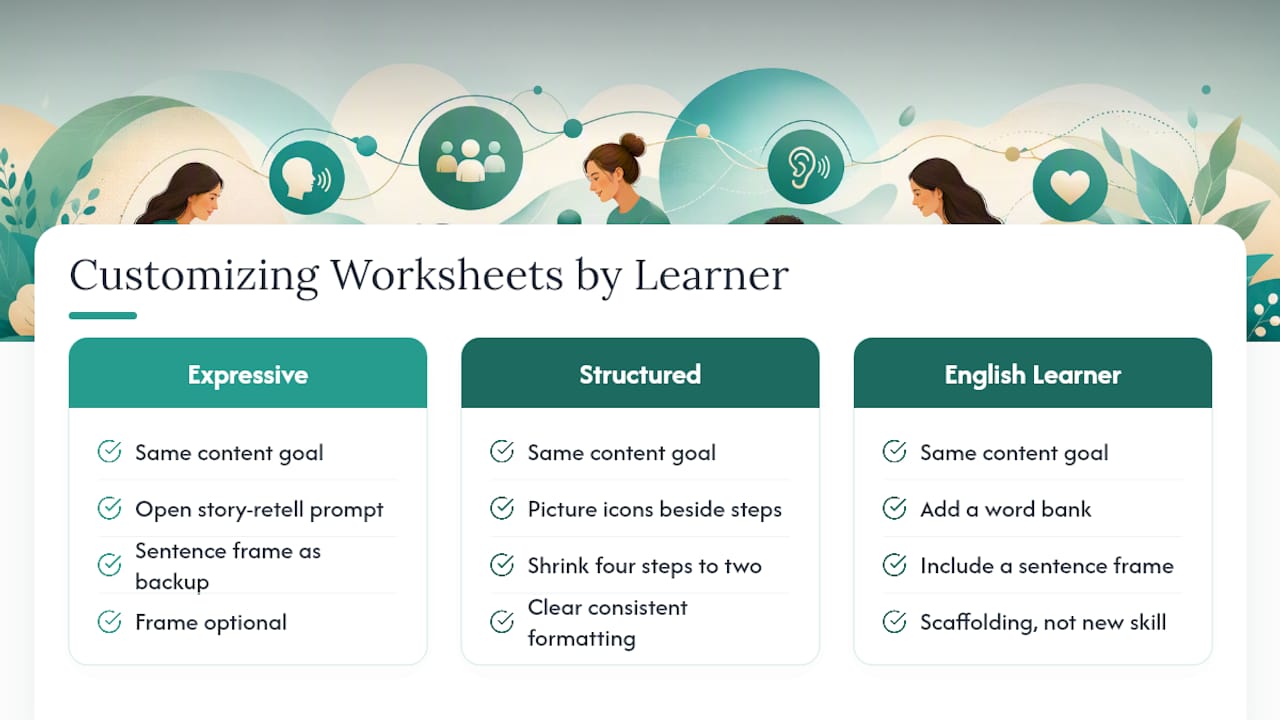
For a child working on expressive language, swap a fill-in-the-blank task for an open story-retell prompt with a sentence frame as backup support, not a requirement. For a child who needs more structure, add picture icons next to each instruction step and shrink the task from four steps to two. For an English learner, keep the content goal identical but add a word bank and a sentence frame, since the skill being practiced doesn’t need to change, only the scaffolding around it does.
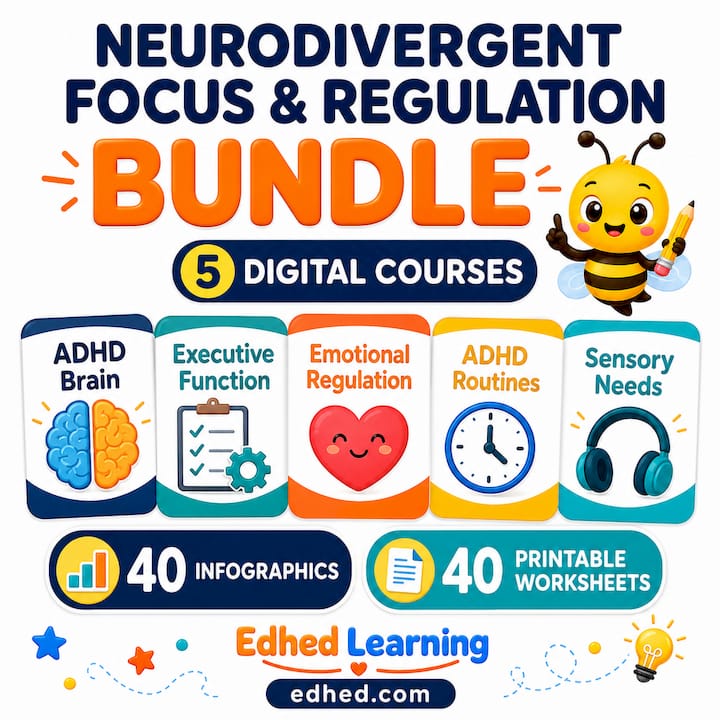
Neurodivergent learners often benefit from worksheets that reduce visual clutter, use consistent formatting across pages, and build in short movement or choice breaks between tasks. A focus and regulation worksheet bundle designed with these learners in mind can pair naturally with a language task, since attention and regulation supports often need to come before comprehension work can land.
Diverse needs also mean diverse home situations. A single parent managing three kids at three grade levels needs worksheets that don’t require constant adult narration to function. Building in a short written instruction line, and picking activities kids can partially self-direct after one modeling round, respects that reality without lowering the learning bar.
Should You Use Digital or Printable Worksheets?
Both formats have a place, and the choice usually comes down to setting and how the child engages best.
Printed worksheets have one advantage digital tools rarely match: they remove the screen entirely, which matters for families trying to limit device time or for classrooms without a one-to-one device policy. A printed page also travels easily between school and home, gets taped to a refrigerator, and doesn’t require charging.
Digital and interactive versions bring their own strengths. Built-in audio prompts help early readers who can’t yet decode written instructions independently. Instant feedback on comprehension questions lets a child self-correct without waiting for an adult. Drag-and-drop sequencing tasks make story-ordering activities feel more like a game than a worksheet, which can matter for a reluctant learner who resists anything that looks like traditional schoolwork.
The most practical approach for most families and classrooms is a hybrid: use instant-download printable packs for the bulk of practice, since they’re cheap, reusable, and require no device, and reserve digital or interactive formats for specific tasks where instant feedback genuinely improves the learning loop. A visual learning and printable practice approach explains why the combination of visual design and hands-on paper practice tends to hold attention better than either format alone for many young learners.
What Goes Wrong With Worksheets, and How Do You Fix It?
Three problems show up constantly, and each has a straightforward fix.
The child guesses the pattern instead of doing the thinking. This happens most with matching and multiple-choice formats. Swap in a generative task, like asking the child to explain their answer out loud or rewrite it in their own words, and the guessing stops working as a shortcut.
The worksheet is too hard or too easy, and the child disengages either way. Fix this by keeping three difficulty tiers on hand for the same skill and switching tiers mid-session if needed, rather than forcing a child through a version that’s clearly wrong for them.
Worksheets pile up without any adult interaction, and progress stalls. A stack of completed pages sitting in a folder doesn’t tell you much on its own. Longitudinal research on home learning environments found that responsive parent-child interaction has a lasting effect on core language skills, well beyond what any standalone activity sheet can produce. Worksheets reinforce a skill, especially when paired with advice on how to support baby language milestones at home. They don’t replace the modeling and conversation that build it in the first place. Set a rule: no worksheet gets handed over cold. Model it once, talk through it together, and let independent practice come after, not instead of, that interaction.
Shaun’s Take on What Makes a Printable Worksheet Actually Work
Most worksheet packs treat visuals as decoration. That’s backwards. A well-placed image isn’t there to make the page look friendly. It’s a second channel for processing the same instruction, and for a lot of kids, especially younger ones or English learners, that second channel is what makes the task solvable at all.
At Edhed Learning, worksheet design starts with a scaffold that fades: heavy visual support and sentence frames on the entry version, less on the stretch version, mirroring how PC-TALK strategies scale adult support down as a child gains skill. That approach comes directly from watching what over 10,000 parents, teachers, and therapists have used successfully. Feedback has consistently shown that measurable, single-goal tasks outperform “do everything at once” worksheets, and that instant digital downloads only matter if what’s inside them respects how kids actually learn language.
— Shaun
Ready-to-Download Worksheet Packs From Theedhed
Theedhed builds instant-download worksheet packs, so you skip the search for reliable, goal-specific activities and get straight to practice. Each pack offers activities designed to support classroom or home learning needs.
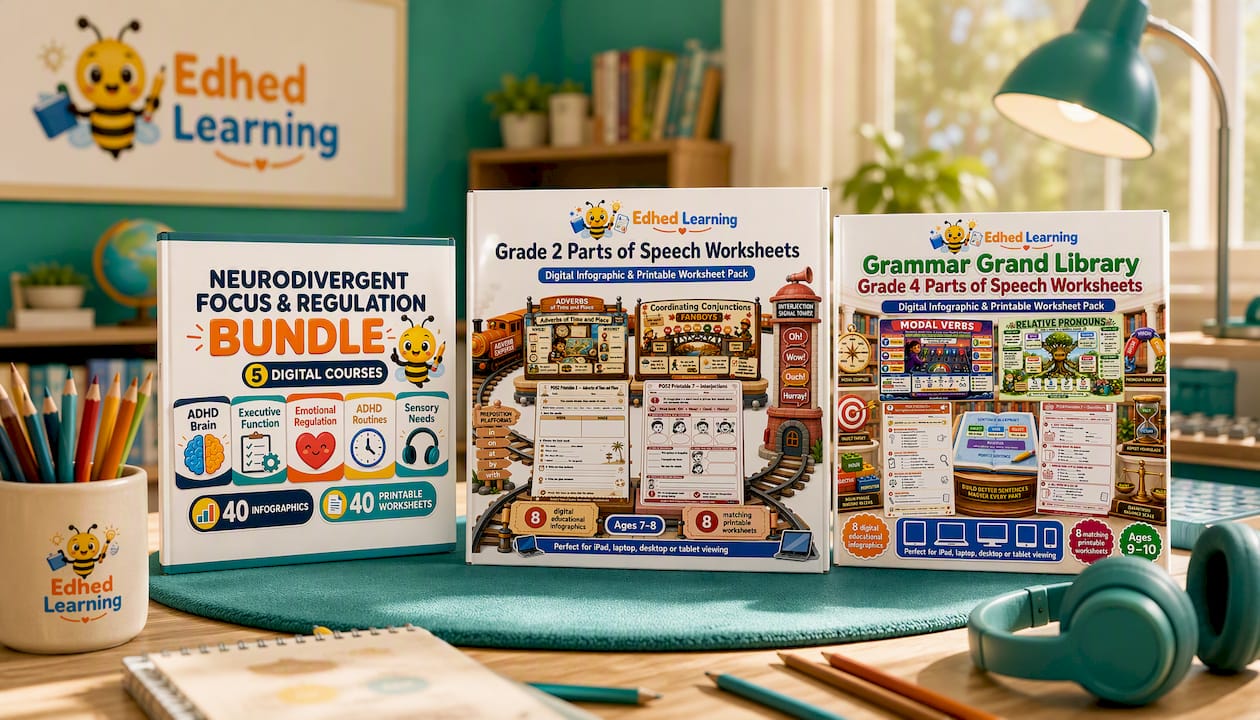
If focus and regulation are getting in the way of language practice, the Neurodivergent Focus & Regulation Worksheets Bundle pairs well with any comprehension or vocabulary task by settling attention first. For grammar practice tied to a specific grade level, the Grade 2 Parts of Speech Worksheets give younger learners a structured, visual introduction to nouns, verbs, and adjectives, while the Grade 4 Parts of Speech Worksheets step up the complexity for older elementary students who are ready for more nuanced sentence work. Select worksheets by age and goal, download instantly, and print for use at home or in the classroom. Explore available worksheets to find those that match your learner’s current needs.
Sources
- How strong is the relationship between caregiver speech and language development? A meta-analysis
- PC-TALK Strategy Handouts — Juniper Gardens Children’s Project / KU
- Educator’s guide for family and caregiver activities — companion to the EL Practice Guide
- What you say, and how you say it: Preschoolers’ growth in vocabulary and communication skills differentially predict kindergarten academic achievement and self‑regulation
FAQ
What Are Speech Therapy Worksheets Used for at Home?
They give parents structured, printable activities for building vocabulary, comprehension, and conversation skills, best used alongside talking through the task together rather than handed over alone.
How Do I Pick the Right Worksheet for My Child’s Age?
Match the task to the goal first, then adjust difficulty with entry, on-track, and stretch versions of the same activity, adding picture support or sentence frames for younger children or English learners.
Are Digital or Printable Worksheets Better for Language Practice?
Printable formats work well for screen-free, reusable practice, while digital versions add instant feedback and audio support; many classrooms and homes use both depending on the task.
How Often Should Worksheets Be Paired With Talking or Interaction?
Every time, ideally. Research on caregiver input consistently links interaction quality to language outcomes, so worksheets work best as a starting point for conversation, not a standalone activity.
Does Theedhed Offer Worksheets for Different Grade Levels?
Yes. Theedhed offers grade-specific packs, including Grade 2 and Grade 4 parts of speech worksheets, plus bundles for neurodivergent learners as instant downloads.


